Filming for Noah Kahan – Concert Drone Videography at Oracle Park
written on 9/2/2026
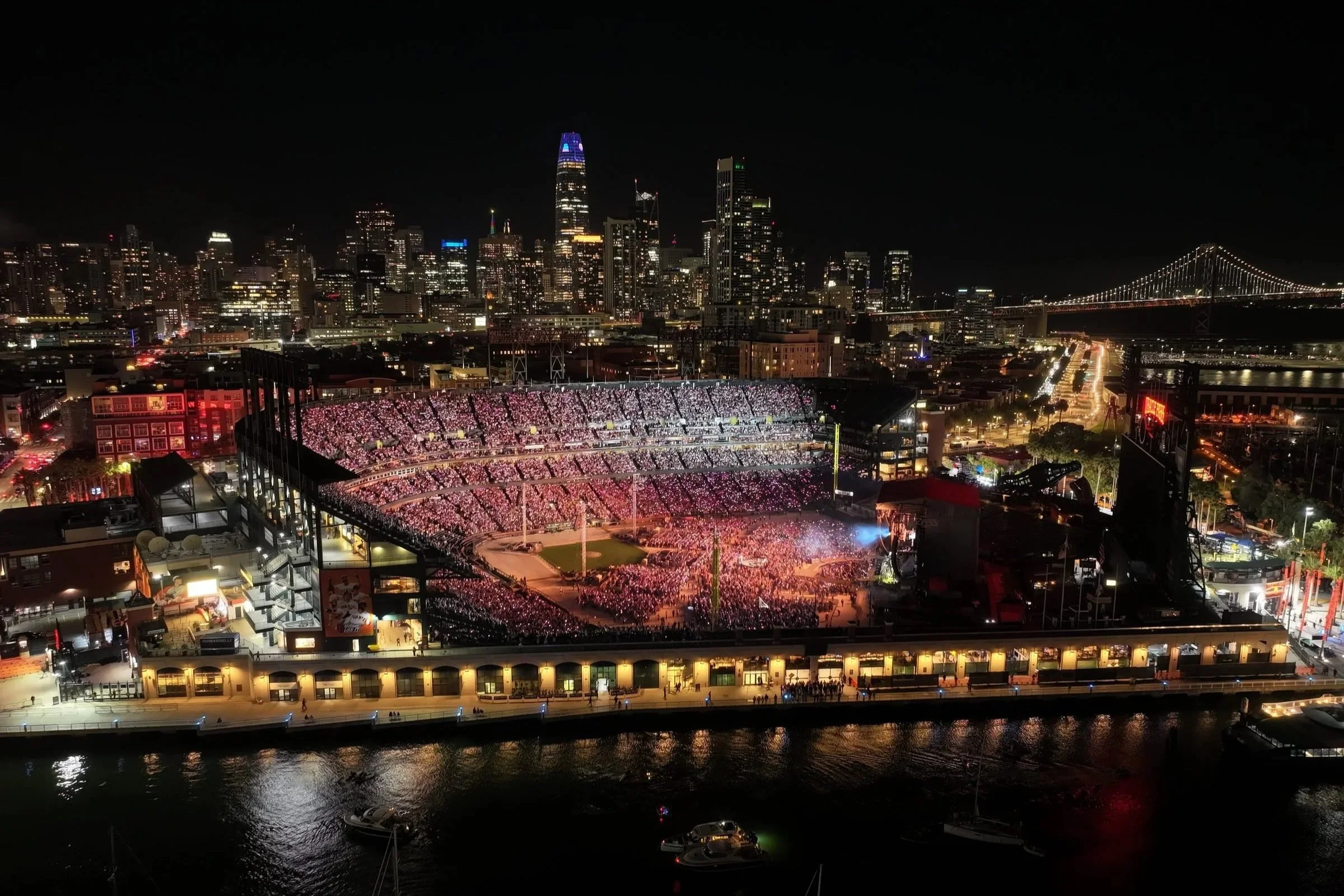
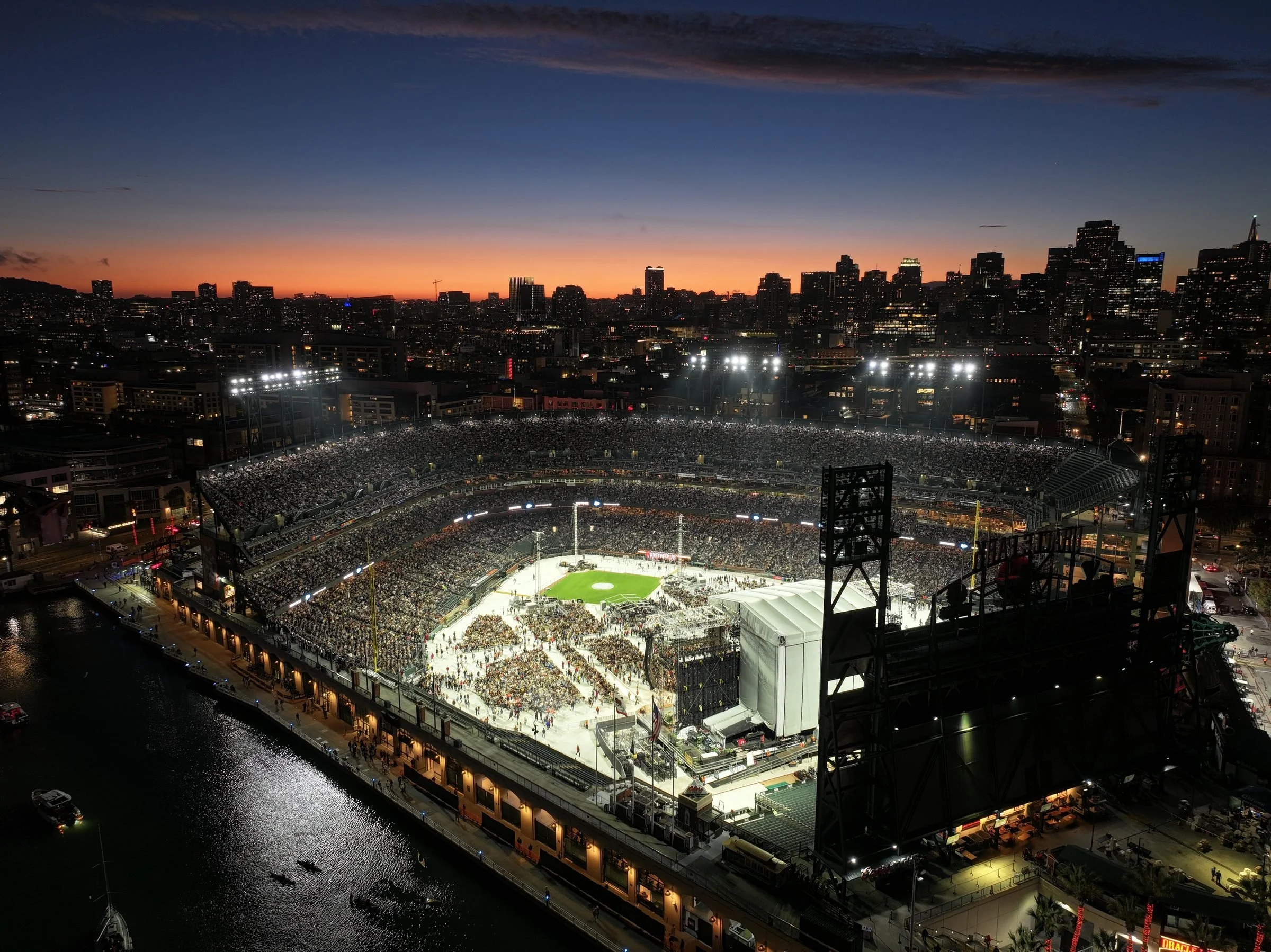
On August 21, 2026, I spent nearly two and a half hours in the air filming Noah Kahan's sold-out concert at Oracle Park in San Francisco. From the opening song through the encore, my job wasn't simply to capture cinematic drone footage - it was to create a complete aerial record of one unforgettable night.
When people think about drone videography, they usually imagine someone launching a drone, grabbing a few sweeping shots, and packing everything up in twenty minutes. Stadium concerts couldn't be further from that reality.
This wasn't stick season…it was late August in San Francisco. But the project still required weeks of planning before the drone ever left the ground.
Between FAA approvals, venue coordination, insurance requirements, flight planning, and carefully timing every battery swap, the success of the production depended just as much on preparation as it did on flying.
By the time Noah walked onto the stage, every detail had already been mapped out.
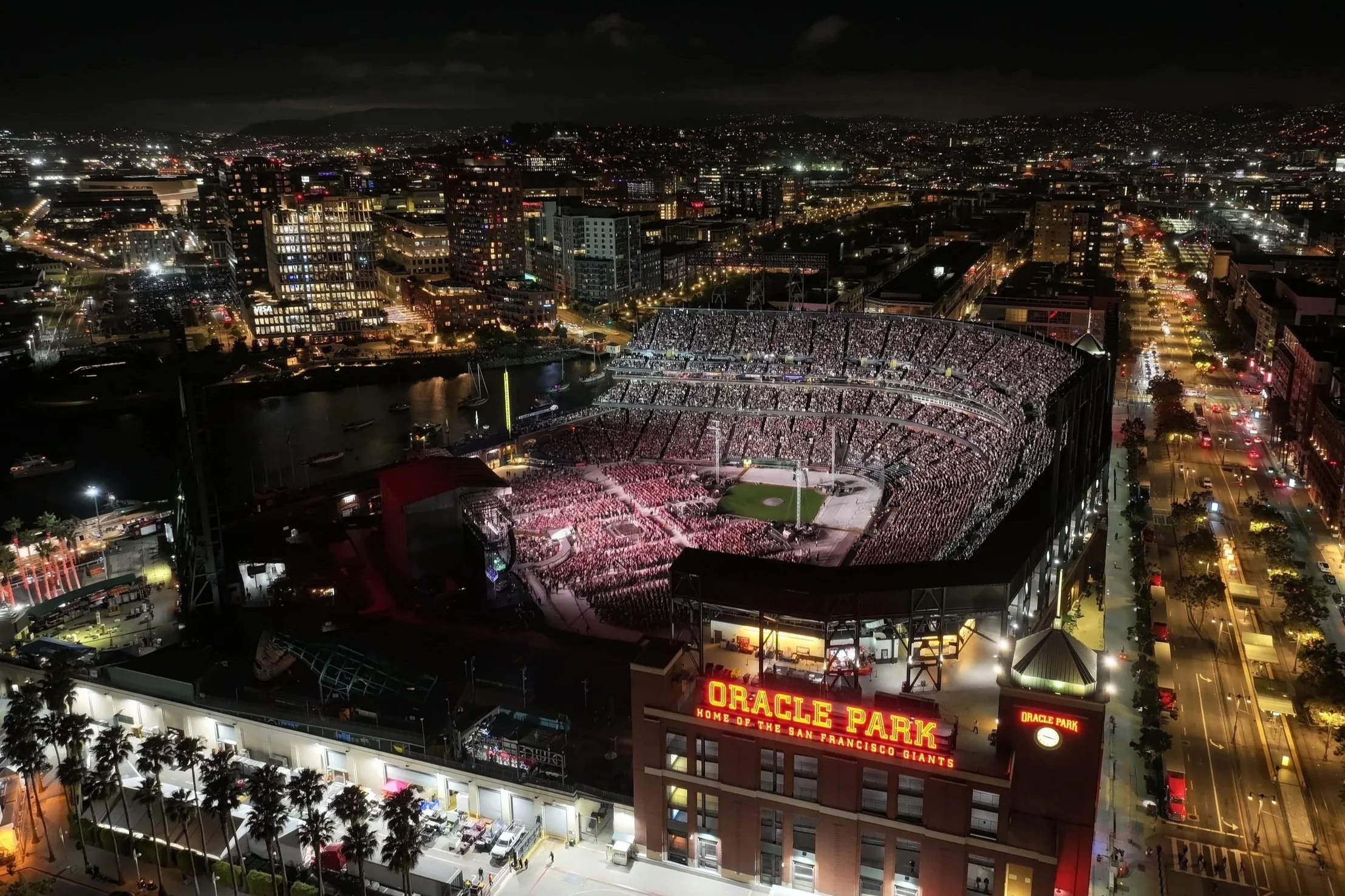
The final result was continuous aerial coverage of his full headline set, capturing the energy of more than 40,000 fans, San Francisco's skyline, and one of the most iconic concert venues on the West Coast.
Here's what it actually takes to film a live stadium concert from the air.
Why Oracle Park Is One of the Most Challenging Venues for Concert Drone Videography
I've flown in plenty of challenging environments, but Oracle Park presents a unique combination of logistics.
It's one of the most recognizable venues in California, sitting directly along McCovey Cove with downtown San Francisco rising behind the stadium. That location is exactly what makes aerial coverage so compelling. Ground cameras can capture the performance, but only a drone can reveal a truly new perspective - the stage, the crowd, the waterfront, and the city skyline all in a single frame.
That same location also makes flying considerably more complicated.
Oracle Park sits within San Francisco International Airport's controlled airspace, and unlike many outdoor venues, it's still an active Major League Baseball stadium. Every production involving a drone has to satisfy both federal aviation regulations and the San Francisco Giants' own operational requirements.
In other words, this wasn't the kind of project where I could simply show up with a drone and start flying.
How I Captured the Entire Show From the Air
Noah's management team wasn't looking for a handful of cinematic drone shots. They wanted it everywhere and they wanted everything. That meant thinking about the footage in two different ways from the very beginning. On one hand, I was creating a permanent archive of a sold-out stadium show that would only happen once.
On the other, I was building a library of individual moments that could be repurposed months or even years later for social media, promotional campaigns, or future tour content. Those two goals sound similar, but they require very different approaches when you're planning a live production with no opportunity for a second take.
Why Drone Coverage at an MLB Stadium Is Harder Than It Looks
Anyone can buy a drone. Not everyone can legally fly one over a sold-out stadium show, and that gap is exactly where a lot of “drone guys” get a client into trouble.
Oracle Park sits inside San Francisco International Airport’s controlled airspace, which meant clearance wasn’t optional - it was the entire front half of this project. Getting approved to fly meant:
Holding an FAA Part 107 commercial drone license, the baseline requirement for any paid aerial work in the US.
Coordinating a Temporary Flight Restriction (TFR) request submitted through local law enforcement to the FAA and TSA weeks ahead of the show.
Completing the San Francisco Giants’ own Oracle Park Drone Use Request, reviewed by ballpark operations and the team’s risk management department.
Securing a $5 million liability insurance certificate that met Major League Baseball’s current drone policy — a bar that’s risen sharply as broadcast rights holders push for more in-stadium drone access.
Submitting a flight plan that stayed strictly perimeter and aerial - never over guests, never over the playing field, with no deviation once approved.
That last point is worth sitting on for a second: the flight plan we submitted, and flew, never crossed over a single fan. Every shot of the crowd was captured from outside the guest footprint, which is both an FAA and venue requirement and, frankly, the right way to fly over 40,000 people. The venue’s risk team was explicit that the only reason our $5M coverage requirement could be discussed at all was because the flight plan didn’t put the drone over guests…fly over the crowd, and the insurance bar goes up accordingly.
None of this is the part clients see in the final video. It’s also the part that determines whether there’s a final video at all.
A drone hovering over a packed stadium isn’t a stunt. It’s a regulated flight, and it should be treated like one
How we flew for over 2.5 hours…
Noah’s set ran close to three hours. A single drone battery gets roughly 25–30 minutes of air time, which meant near-continuous coverage was never going to happen on one battery, or even three or four.
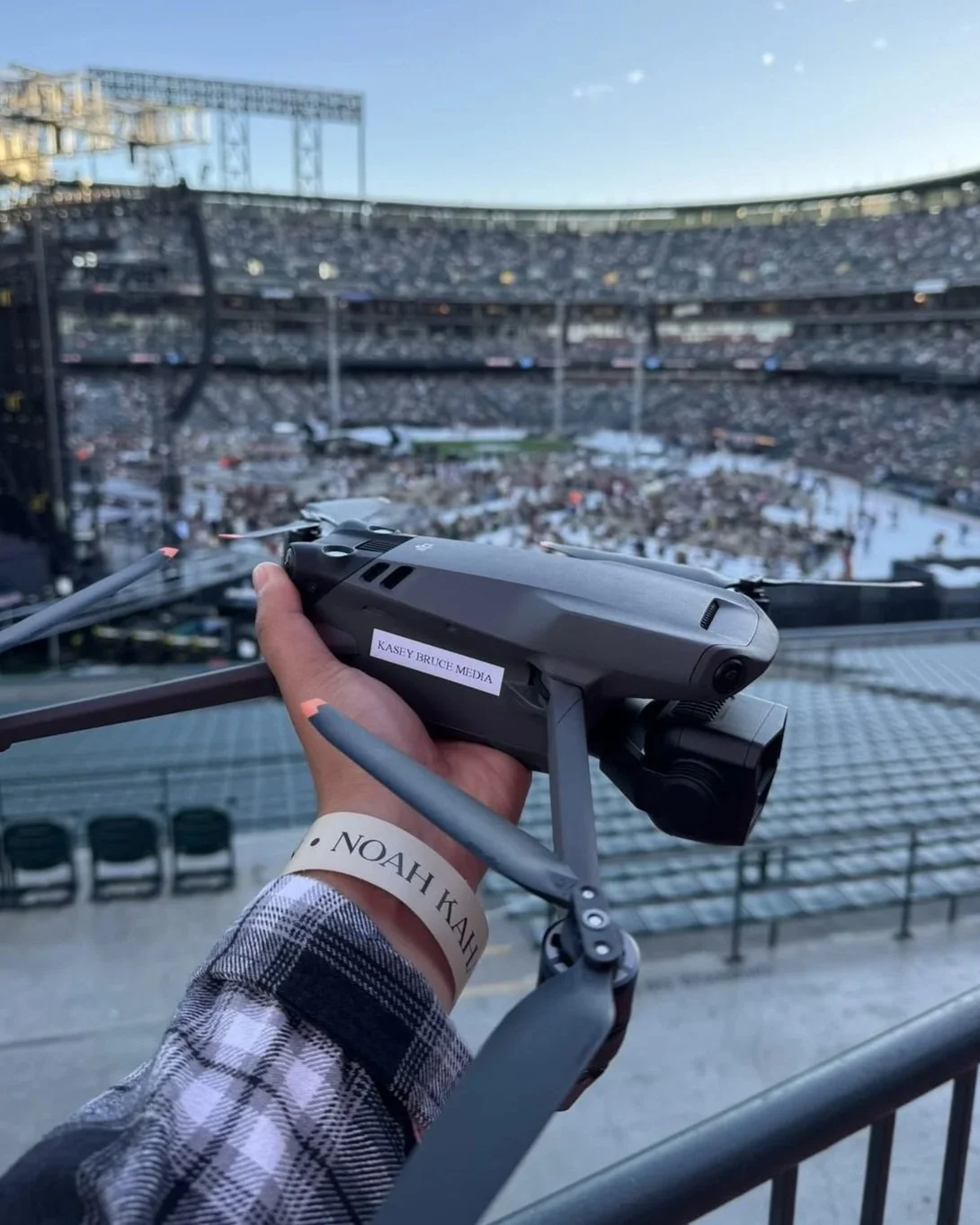
We flew a Mavic 3 Pro setup with a rotation of 8x freshly charged batteries swapped throughout the night, supported by an assistant acting as visual observer (VO). A V.O. is someone dedicated to spotting the airspace, watching for other aircraft, and keeping the swap turnaround tight so gaps in coverage stayed brief and predictable rather than random. San Francisco evenings at the ballpark also bring fog that rolls in fast off the Bay, which made having a second set of eyes on conditions non-negotiable, not optional.
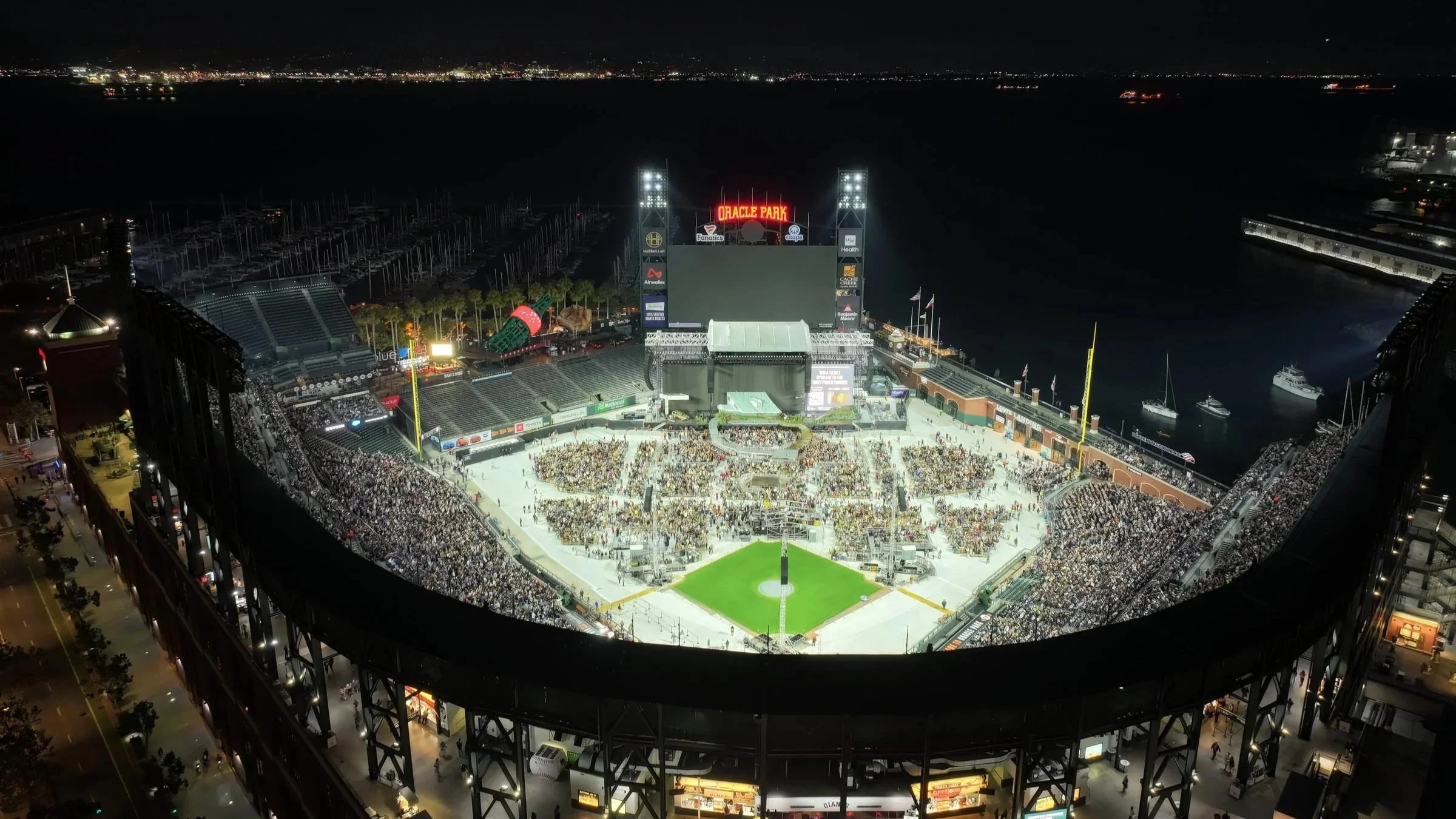
Before the show, Noah’s team shared a marked-up set list noting exactly when the show moved between the main stage, a secondary stage, and a third smaller stage, plus the songs where fireworks would fire. That single document changed how we flew the whole night. Instead of guessing where the next big visual moment might happen, we knew - and we could position for it in advance instead of reacting a beat too late.
We launched and landed from the Baseball Glove section, in coordination directly with Oracle Park’s operations team, arrived hours before doors to walk the site and confirm the plan, and picked up event credentials the same way any other production crew does — through the venue’s standard media and touring-crew access process.
Finding the Shots That Tell the Story
One of the easiest mistakes in concert drone videography is assuming the stage is always the subject. (It isn't.)
My role as a Creative Storyteller was to capture; the show, the city, and the crowd in a way that actually felt like San Francisco, on this specific night, at this specific show.
A few of the moves that shaped the final footage:
Pulling back to reveal the city.
Some of the strongest shots weren’t tight on Noah at all - they were wide reveals that started on the stage and pulled back until the Bay Bridge, the downtown skyline, or the lights of the city came into frame. That’s a shot a ground camera simply can’t get, and it’s the kind of image that tells a viewer where they are before it tells them what’s happening.
Treating the crowd as its own subject.
With 40,000-plus fans singing along, the crowd was as much a part of the show as the stage. We flew high, wide passes during the biggest sing-along moments - the kind of shots where a sea of phone lights and raised hands does more storytelling in three seconds than a highlight reel of stage footage could do in thirty.
Timing songs to shot types.
Using the set-list notes, we matched slower, more emotional songs with slower, more deliberate camera moves, and saved faster, sweeping passes for the higher-energy points in the set. During fireworks, we held a wide, static position outside the marked impact zone rather than moving — the kind of restraint that keeps footage usable instead of shaky and reactive.
Working the transitions.
The brief gaps between stage changes weren’t downtime - they were battery-swap windows, planned in advance instead of scrambled through in the moment.
San Francisco evenings bring their own kind of northern attitude…Karl the fog that rolls in fast off the Bay with zero warning, high wind gusts, and the occasional seagulls that get a little to close for comfort.
Preparation is what allows you to adapt without sacrificing safety.
Every Minute Before Doors Open Matters
Long before fans began filling the stadium, I was already on-site walking launch locations, confirming communication procedures, checking weather conditions, reviewing emergency contingencies, and coordinating directly with Oracle Park operations. Like every other member of the production team, I checked in through credentialing, followed venue procedures, and worked within the same operational framework as the rest of the event staff.
People often assume the exciting part of drone work begins when the aircraft takes off. In reality, by the time I launch, most of the work has already been done.
Flying is simply the execution of a plan that's been built, reviewed, and refined well before the first battery is installed.
What This Kind of Footage Is Actually For
One thing I've learned from working with artists, brands, and production teams is that footage rarely has just one purpose.
It's easy to assume the end goal is a sixty-second highlight reel posted the following week, but that's usually only the beginning. More often than not, the footage first becomes part of an archive—a carefully organized library documenting a specific night on tour. Months later, someone may revisit that footage while producing a documentary, announcing another tour, celebrating an anniversary, or creating entirely new promotional material.
That's why I approach these productions with the mindset of building assets rather than simply delivering clips.
A single concert generates content that can continue creating value for years. One wide establishing shot might become part of a tour recap. Another clip could end up in a social campaign six months later. A few seconds of aerial footage might eventually appear in a documentary or promotional film years after the concert itself.
When you think about the footage that way, the planning starts to make even more sense.
Every flight, every battery swap, every decision about framing or timing is ultimately in service of creating a collection of images that won't need to be recreated because they can't be recreated. Live performances are fleeting. Once the lights come up and the trucks leave the loading dock, that particular combination of artist, venue, audience, weather, and atmosphere disappears forever.
That's part of what makes this kind of work so rewarding. You're documenting something that only existed once.
Experience matters more than Equipment
Technology has made drones more accessible than ever, and that's a wonderful thing for the industry. But accessibility has also created the impression that professional drone work is primarily about owning the latest aircraft.
In my experience, the equipment is rarely what separates one operator from another.
What matters is knowing how to navigate complex productions, communicate with venue operations, understand aviation regulations, anticipate problems before they happen, and adapt when conditions inevitably change. Those are skills that don't appear on a specification sheet, but they're the reason projects like this come together successfully.
By the time I launched at Oracle Park, there wasn't much left to figure out. Every conversation with the venue had already happened. Every approval had already been secured. Every member of the production team knew where I would be operating and what to expect throughout the evening.
That's exactly how it should be.
The drone is simply one tool in a much larger production. The real work happens weeks in advance.
FAQ: Drone Coverage for Concerts and Live Events
-
It starts with an FAA Part 107 commercial drone license, which is the legal baseline for any paid drone work in the US. From there, venues in controlled airspace, like Oracle Park inside SFO’s airspace, typically require their own use request, a reviewed flight plan, and proof of liability insurance that meets the venue’s (or league’s) specific policy. For MLB venues, that process runs through the team’s operations and risk management departments and can take several weeks.
-
A single battery typically lasts 25–30 minutes. For a show that runs close to three hours, that means flying in rotations with multiple charged batteries and a dedicated person managing swaps, rather than relying on one continuous flight. Near-continuous coverage of a full set is possible, it just takes the right gear, battery count, and crew to pull off.
-
Flying directly over guests carries real risk and, at most professionally managed venues, requires significantly higher insurance coverage, if it’s permitted at all. The safer and more common approach is a perimeter flight plan that captures sweeping crowd and stage shots from outside the guest footprint, which is how this show was flown from the airspace request through the final shot.
-
Licensing, insurance, and process. A Part 107 license, an FAA and TSA-cleared flight plan, and a liability policy that meets a venue’s actual requirements aren’t optional extras, they’re what makes it legal to fly at a professional venue at all. A budget operator without that paperwork isn’t a cheaper version of the same service; they’re a liability risk wearing a discount.
-
Yes, and planning for both from day one is what makes the difference. Archive footage needs full coverage of the performance; social footage needs short, self-contained moments that work without context. Shooting with both goals in mind from the start means one flight plan can deliver a complete record of the night and a bank of clips ready to post.
-
For a controlled-airspace venue like an MLB ballpark, plan for at least three to four weeks before the event. That timeline covers the venue’s own drone-use application, insurance certificate review, and, depending on the airspace, a Temporary Flight Restriction request that has to clear the FAA and TSA. Smaller, uncontrolled venues can move faster, but the paperwork is never something to leave until the week of the show.
Want aerial or ground video coverage for your next… show, launch,
or campaign?
Book a discovery call with Kasey Bruce Media.